Showing posts with label quilting. Show all posts

DIY Rice Therapy Pillow

I wanted to make a small project involving piecing and was something useful that I don't already have. Enter the Rice Therapy Pillow. These are great little pillows that can be used hot or cold to relieve aches and pains or warm up cold feet. You simply store the bag in the freezer for cold therapy and microwave it for a few minutes on high for warm therapy. 


I made a removable cover for the pillow using pieced right square triangles in dark blue and neon green.


In My Library - Quilting Books

Over the years I've collected a few quilting books for my library. I find books so inspirational to look through as well as being where I most often brush up on techniques and how-tos. My collection of quilt books is much smaller than my sewing or knitting books. I see it as the beginning of a collection. Do you have favorite quilting books? Anything that you'd like to own?

1. Patchwork Style by Suzuko Koseki  See my review here. I'd love to check out her other book Natural Patchwork.

2. Quilts by Denyse Schmidt I have loved Denyse Schmidt's design style for years. The first time I saw her quilts I was immediately mesmerized. If pinterest was around then, I definitely would have pinned like crazy. This book does not disappoint. It has a variety of projects from simple coasters (see mine here) to full size quilts.

3. Quilts, Quilts and More Quilts! by Diana McClun and Laura Nownes This is the "text" book from the beginning quilting class I took. I used the book a lot while taking the class and it does a great job of showing how to make classic quilt block designs and basic techniques.

4. The Quilters Ultimate Visual Guide by Ellen Pahl This book is a helpful reference guide. It's organized alphabetically which is a fun device yet I felt like it would be a little more helpful if the techniques were in order of use and how they related to each other.

5. Scrap Quilts Fast and Fun by Patricia Wilens This book has basic instructions for some classic quilts and basic techniques with helpful photos.

6. Ghost Layers & Color Washes by Katie Pasquini Masopust This book shows the author's technique of   layering fabrics to create interesting art style quilts.

7. 5,500 Quilt Block Designs by Maggie Malone This book is full of basic quilt block drawings. It doesn't show how they look put together in a quilt but is pretty comprehensive.

8. Quilts from Happy Hands by Sandra L. Wright I found this book in a thrift store. The first part of the book has color photos of finished quilts and the rest of the book has detailed illustrations for how to make the designs. There's definitely a strong 80s vibe to this book but choosing more current fabrics would easily update the designs.

Thursday Vintage – Quilts

My Grandma Louise pieced these two quilts in the 1930s (I think) and then stored the quilt tops in flour sacks. About 10 years ago, my family had them quilted. The one above is known as a Double Wedding Ring quilt. Aren't those fabrics to die for? There are lots more pictures after the jump.


Blue Strips Pillow Cover

Here's a fun pillow cover that I made from strips of fabric pieced in angles. I purchased the pillow from IKEA. It was really cheap and came with a removable cover. Now the fabric strips is a longer story. Would you believe that this fabric started out as a jumble of long strips?


A number of years ago, I got a stash busting idea to cut all of my blue colored and calico fabric into 1.5 inch strips. I pieced all of the strips together into longer strips and then hung them like a curtain in front of an open closet. It was a fun decoration but for the last 5 to 7 years, they've been sitting, jumbled in a plastic bag in the closet. I pulled apart the strips, ironed them and hung them up on a rack, out of the way and at little risk of wrinkled.


I pieced the strips along the long edges to make a kind of "fabric". Then I cut the "fabric" at a 45 degree angles to make this new design. It was pretty improvisational. I didn't know what I wanted to end up with but I really like how it turned out. The back of the pillow has two overlapping pieces of fabric allowing the cover to be changed out as desired. 

This morning I thought of an idea for a quilt using these strips and large pieces of white fabric. So many ideas. So little time!!

Sashiko Kit - Mini Tote Bag

Sashiko Mini Tote Bag
I made this cute little sashiko bag using a kit that my brother and sister-in-law gave me last Christmas. I had never done this kind of embroidery before but it was a pleasant activity. I'd say fun, but come on. 
The kit comes with thread and pre-printed fabric with dashed lines showing you where to stitch. (I found a kit online here.) You can choose to make either a mini tote or a half-apron. I already have a lot of aprons that I never use so I chose to make the tote. 


Top 10 Most Useful Tools for Quilting


These are the tools I find most essential for cutting, piecing and quilting. These might actually be my most useful tools for any sewing project. And some of them are useful for other kinds of craft projects like cutting paper or measuring stuff. So check 'em out!

1. Self-Healing Cutting Mat
A self-healing cutting mat is essential whether you're using a rotary cutter on fabric or an exacto blade and paper. The mat will protect your work surface from being damaged by the blade. As you can see from mine above, the mat does reveal wear and tear over time. This mat is probably over 10 years old and I use it all the time. Considering that, it's still in pretty good shape. This mat is the type sold in art supply stores and is a little thicker than the ones found in the quilting supply section of the craft store. I also have a thinner cutting mat but I find myself only using the more heavy duty one. Mine is 24 x 18 inches which works well for most projects. I occasionally find myself wishing for something larger but it would be a nuisance to store. 

2. Transparent Grid Ruler
This is the best kind of ruler for cutting precise geometric pieces of fabric or even paper. I mostly use my 6 x 12 inch but when I'm cutting a longer piece of fabric I use a 6 x 24 inch ruler. There are lots of different sizes but I've been perfectly satisfied with these two. If I were to buy another, it would be a square, larger than 6 inches.

3. Rotary Cutter
This little blade works like a pizza cutter. Using this along with your self-healing mat and your transparent ruler, you'll be able to quickly and accurately slice up fabric. The blades are easily replaced by unscrewing the the center nut.

4. Iron
I invested in a Rowenta iron a few months ago and it's so nice. Ironing is essential whether you're making quilts or making clothes. I couldn't live without mine.

5. 1/4 inch piecing foot
This sewing machine foot is built to scale so you can easily stitch a 1/4 inch seam. Simple as that. A 1/4 inch seam is the standard for most quilting projects. Why is it important? If you veer from that measurement, your design mat not fit together correctly and it will look wonky and you'll be sad.

6. Quilting foot
This little gem helps you sew layers of fabric together by moving the top layer of fabric just as the feed dogs move the bottom layer of fabric. Without it, your fabric could get stretched out and yucky on the top layer. This foot is also great for sewing knit fabrics.

7. Long straight pins
Ever since I started using these luxurious long pins with lovely colorful beaded heads, I've known I could never go back to a little stubby pin. These pins are easy to pick up and handle and hold the fabric together steadily. What more could you ask for?

8. Small Scissors
Use these little snips to trim threads at the machine. It's so much easier to pick up a small pair for quick clip than a bulky full size one. And a small pair of scissors fits nicely on a crowded sewing table. 

9. Disappearing ink fabric pen
Well, how can you not want a disappearing ink pen? Use this pen to mark your stitching lines when stitching across the interior of a fabric.


10. Seam Ripper
We all make stitching mistakes from time to time to all the time (or so it seems some days). The seam ripper will get rid of them. Invest in one with an ergonomic handle and you won't regret it.

Is there anything I left out? What tools can you not live without?

Pink Squares Quilt

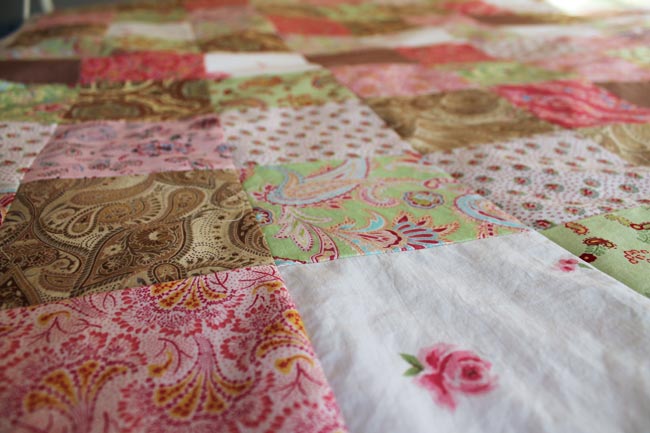
I started making this quilt around the time I took the quilting class. I first imagined it as a random pattern of pink and green patterned squares with circular appliqués. So, 7 years later I've finished piecing the squares. 

So, the question remains whether to do any appliqué on this quilt. I was thinking maybe simple circle embroideries could be interesting. The thing still needs to actually be quilted which will bring another design element to the piece. What do you think? Does it need something else? 


More photos after the jump...

Craft from the Past – Quilting Class Blocks


I took a quilting class about 7 years ago at a small quilt shop in Springfield, Oregon. I'd been wanting to try quilting but didn't know how to begin so I thought that a class would be the best way to go. The class was really great at teaching the beginning basics – measuring, cutting, piecing and pressing – by making a series of classic quilt squares. Although, I haven't done much quilting since the class, it was a really valuable experience and well worth the time and expense.

See more photos after the jump.


Thursday Vintage - September 6

This lovely velvet pillow was made by my grandmother Louise and her sisters. I seem to remember that there were a few of these pillows but I only have one now. The design is a kind of modified log cabin.

Here's the reverse side of the pillow. The velvet is soooo soft. You wouldn't believe it. This precious little pillow sits on a chair in my living room. It really deserves more regular attention.

DIY Vintage Double Knit Coasters with Mini Tutorial

Have you ever noticed that some people are coaster people and some, well aren't? In my family, we're coaster people. And by coaster people I mean, if some non-coaster person puts a drink on that wood surface without at least a magazine in between an internal panic attach will likely ensue. Of course, the anxiety is easily relieved with a casual "Oh here's a coaster" move. A move made all the easier by having a stack of lovely coasters at the ready.


Read more after the jump...

September Theme – Quilting


Quilting has always appealed to me as a great way to combine two dimensional design and craft. I took a quilting class about 6 or 7 years ago and I've started a few quilts but never actually finished. So, in order to jump start my quilt making, I'm making quilting and piecing the theme for September. This month I'll be sharing inspiration, works in progress and hopefully some finished projects too. I hope that you will come back and visit throughout the month.

Free Pattern Recycled Corduroy Blanket

This recycled corduroy blanket is one of my all time favorite projects and beyond a doubt the best blanket in the world. I know that might be hard for you to believe but that's only because you have not taken a nap or watched tv with this blanket. If you did, you'd know that it is the best blanket in the world.
I made this blanket about 6 years ago using wide wale corduroy (you remember that 90s fave fabric right?) that I rescued from the Goodwill pile. Wide wale corduroy has those soft, fat ridges of fluff. 
The blanket is made of alternating columns of corduroy squares and narrow rectangles with a backing of microfleece. The pattern is available for FREE on my website.

If I were to do it all over again (which I hope to one day in lovely neutral colors), I'd use a larger seam allowance and actually quilt (topstitch) the top of the blanket. I've had issues with the seam coming apart on this quilt but I just use a narrow zig-zag (buttonhole stitch) to tack the fabric down and all is right again.

Between the microfleece and the wide wale corduroy this blanket is so soft and has the perfect heft to it. And, very importantly it's long enough to fit over my feet and still cover my arms (about 70 inches long). That's maximum warmth and there's not much else you can ask for in a blanket. Seriously, best blanket ever.

Book Review - Patchwork Style

Patchwork Style by Suzuko Koseki is a lovely little Japanese book full of quilting projects. The first section of the book has color photos of the projects with short descriptions. The second half contains instructions and black and white illustrations.
There are a lot of bag and purse projects plus a few quilts and other home goods. Many of the projects are perfect for using up scrap fabric. I've had this book for a while but only recently made something from it. Tune back in tomorrow to see my creation.

The illustrations are excellent with lots of detail. They are not always on the same page as the instructions though, so one must flip back and forth a lot. The instructions are fairly good, very detailed and the wording is not awkward. I did think some steps were a little confusing but not in a very frustrating way.
Overall I think this is a great little book and I can't wait to try more projects.

The etsy blog has the coaster pattern available for free if you'd like to try out one of the projects.
Check out the Patchwork Style flickr group to see finished projects.